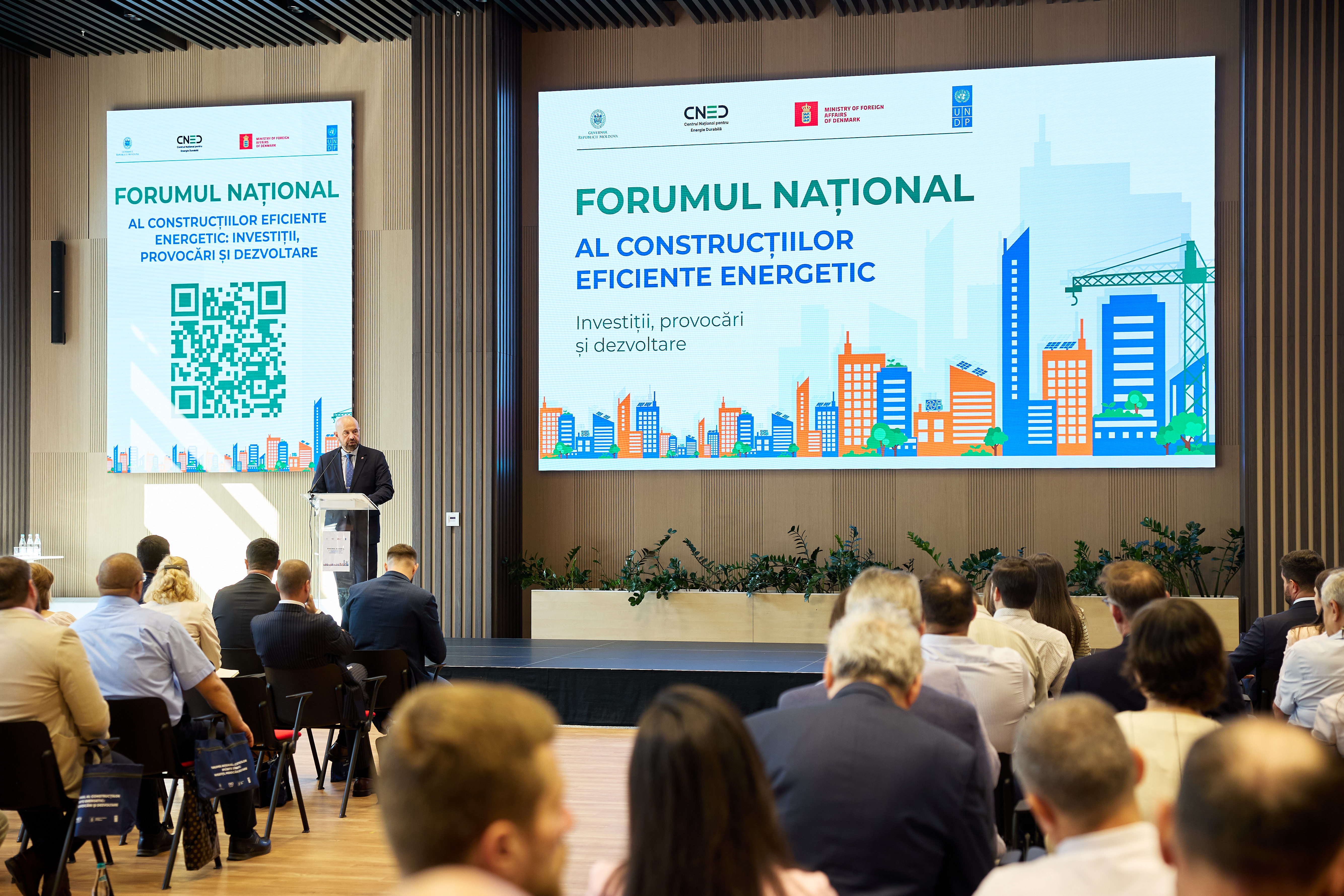
National Forum on Energy-Efficient Construction Highlights the Need to Accelerate Sustainable Investment
- 409 reads


The National Forum on Energy-Efficient Construction: Investments, Challenges and Development, held on 27 May in Chișinău, highlighted the need to accelerate investment and strengthen the construction sector’s capacity to turn available financial resources into concrete large-scale energy renovation projects.
The event was organized by the National Center for Sustainable Energy (NCSE), in partnership with the Ministry of Energy, the Ministry of Infrastructure and Regional Development, UNDP Moldova, with financial support from the Government of Denmark.
Given that more than half of the country’s final energy consumption comes from the buildings sector, energy efficiency has a direct impact on the economy, competitiveness, and sustainability. At the same time, programmes such as the Residential Energy Efficiency Fund of Moldova (FEERM), alongside investments in public buildings, are generating significant financial resources that require increased capacity for absorption and effective implementation within the construction market.
The Forum highlighted reform priorities and investments in the sector, including the strategic role of government policies in supporting the energy-efficient construction market.
“Building construction and energy efficiency, when properly implemented, reduce the environmental impact and improve residents’ comfort. It is important for the authorities to provide clarity and predictability. I confirm our readiness to support this sector, discuss the challenges it faces, and identify solutions. New buildings must comply with quality standards and contribute to reducing energy consumption,” said Victoria Belous, Deputy Chair of the Parliamentary Committee on Economy, Budget and Finance.
Vladimir Bolea, Deputy Prime Minister and Minister of Infrastructure and Regional Development (MIDR), highlighted the need to strengthen the sector’s capacity to implement complex projects and respond to the growing demand generated by national programmes.
“Legislation must keep pace with current realities. Climate change is already making its presence felt in our daily lives, while construction technologies and materials are evolving at an accelerated pace. We need a flexible and modern regulatory framework that allows for rapid adaptation to new requirements and to the way we build today. MIDR remains open to ongoing dialogue with representatives of both the construction sector and the energy efficiency sector. When innovative solutions emerge that are not yet sufficiently regulated, I encourage the business community to come forward with clear and well-founded proposals so that, together, we can develop an updated legislative framework tailored to market needs and sustainable development objectives,” said Vladimir Bolea.
Discussions also focused on expanding financing mechanisms and aligning the market with European standards, as investments in energy efficiency are increasingly structured through dedicated instruments, including grants and co-financing mechanisms for homeowners’ associations and public buildings.
Minister of Energy Dorin Junghietu emphasized that energy efficiency in buildings can generate a significant economic impact:
“Investments in the energy efficiency of buildings have a direct economic and social impact on citizens. We are talking about lower energy bills, warmer homes, and greater comfort for people. The results of the programmes implemented so far show that energy efficiency in buildings is one of the most effective solutions for reducing consumption and strengthening the country’s energy resilience. We will continue to develop and expand these initiatives so that more families in Moldova can enjoy better living conditions.”
International experiences were presented as relevant benchmarks for the development of the sector, including in terms of private sector involvement and the efficient use of financial mechanisms in energy renovation projects.
“Today, we are entering a new stage of energy efficiency: moving from policy ambitions and strategic intentions to large-scale implementation, operational programmes, concrete investments, and measurable results. However, investment alone is not enough. Equally important is the capacity of the private sector to effectively respond to the growing demand for energy-efficient construction and renovation. That is why we are prioritizing accelerated professionalization. This means enhanced technical skills, quality standards, and modern technologies,” said Seher Ariner, UNDP Deputy Resident Representative in the Republic of Moldova.
Ion Muntean, Director of the National Center for Sustainable Energy (NCSE), spoke about financial solutions for the energy renovation of apartment buildings developed through the Residential Energy Efficiency Fund of Moldova (FEERM), managed by NCSE.
“Energy efficiency is no longer just a public policy objective, but a strategic investment in energy security, economic competitiveness, and citizens’ quality of life. In recent years, we have built sustainable financing mechanisms and launched programmes that are already delivering concrete results. At the same time, this process has clearly shown us where the market’s vulnerabilities lie. Today’s Forum is an open invitation to dialogue and cooperation, so that together we can identify solutions to accelerate the development of a strong, high-quality, and energy-efficient construction sector in the Republic of Moldova,” said Ion Muntean.
FEERM has a budget of more than MDL 1.4 billion through the end of 2027 and provides for the renovation of at least 507,000 square metres of heated residential space over the next three years, 75% of which consists of residential buildings. Financing instruments include grants covering 70% of the eligible investment for homeowners’ associations in condominiums, with a contribution of only 30% from beneficiaries. Energy-vulnerable owners of apartments and individual houses will receive allocations covering up to 90% of their contribution, financed through the Energy Vulnerability Reduction Fund.
UNDP and Denmark will support the preparation of energy audits for 10 business incubators and 25 apartment buildings. These audits will serve as the basis for investments aimed at reducing energy consumption and energy bills. A further 43 energy audits of apartment buildings and medical institutions have been carried out with funding provided by the European Union and Italy.
In addition, UNDP, using funding from the EU, Italy, and the Global Environment Facility (GEF), has installed photovoltaic panels at nine district hospitals.
The Forum brought together more than 150 representatives of the construction sector, financial institutions, public authorities, and international organizations, providing a platform for dialogue on the implementation of energy efficiency policies and investments, including in the context of the Sectoral Strategy for the Renovation of the National Building Stock 2025–2050, developed with the support of UNDP, the Energy Community Secretariat, the EU, and Denmark.
Images