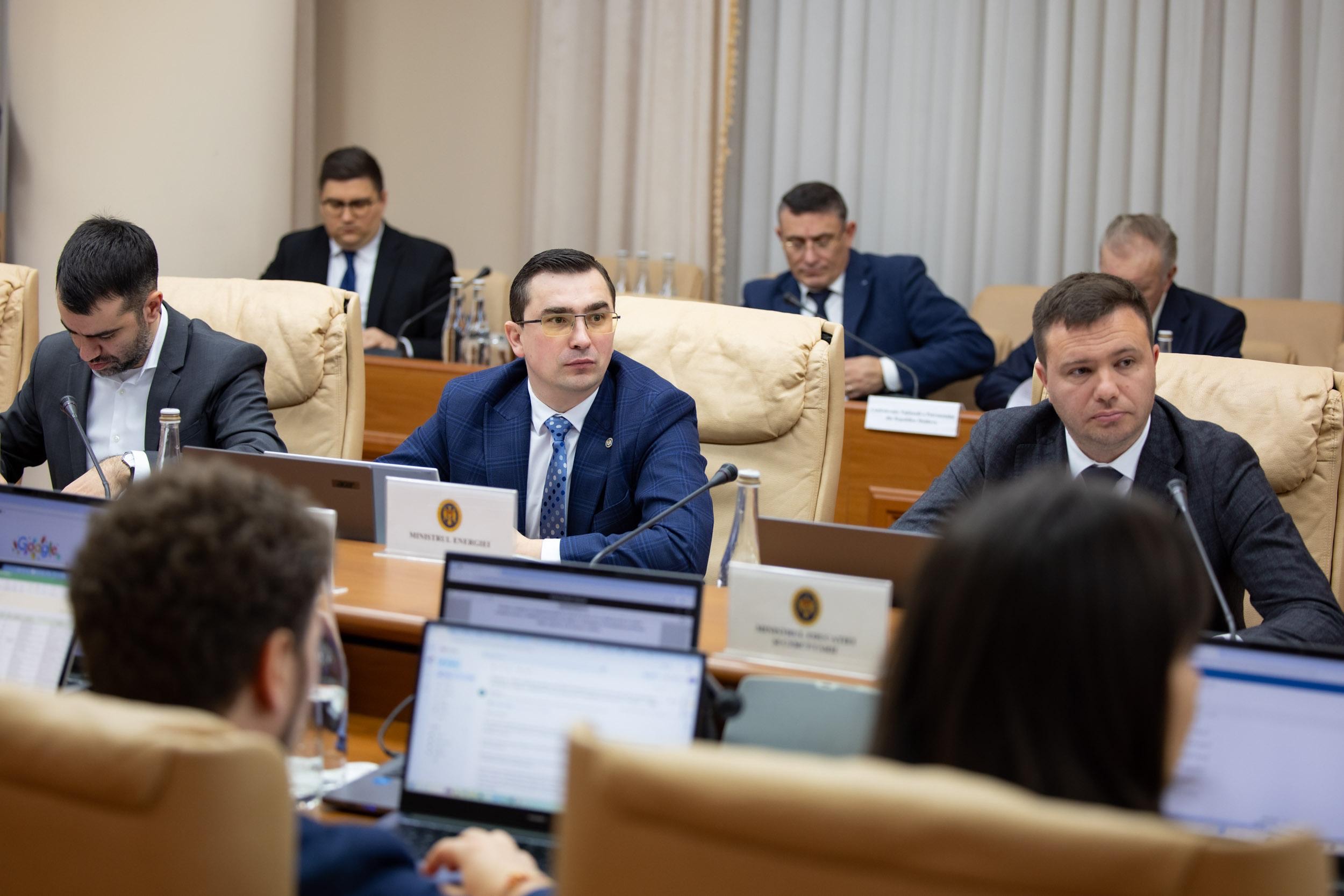
The Government approved the Regulation and Anti-Crisis Action Plan in the Electricity Sector
11-12-2024 09:26
777
- 777 reads
December 11, 2024, Chisinau - The Government is strengthening the response capacity of the authorities to risks in the electricity sector by developing a clear legal framework for the prevention and management of crises. In this regard, the Cabinet of Ministers approved today the Regulation on exceptional situations in the electricity sector and the related Action Plan, developed by the Ministry of Energy.
The document includes 29 crisis scenarios and measures to prevent or mitigate the impact of possible exceptional situations in the electricity sector. The plan details preventive and intervention measures for each scenario, depending on the triggering factor, such as fuel shortage, electricity market failure, malicious attack, extreme weather, etc.
In one of the possible scenarios, which foresees general deficiencies in the supply of fossil fuels, producers, at the request of the transmission system operator (TSO), will ensure the maximum increase in the production capacity available to producers. Measures will also be implemented to reduce or cancel the commercial capacity of the auctioned interconnection, as well as to reduce or cancel the notified export transactions. The TSO will request emergency assistance from the transmission system operators of neighboring countries, in accordance with bilateral agreements. The norms of gradual disconnection will be applied and the withdrawals from operation of equipment for maintenance or investment reasons will be canceled.
At the same time, it is planned to protect priority consumers, such as medical institutions, kindergartens and schools, so that social services of major importance are not stopped.
Another scenario, presented in the Plan, describes the overloading of the electrical networks due to the use of electrical devices for heating. In the event of such a scenario, the authorities will apply measures to redistribute the loads in the network, consolidate low-voltage networks and implement demand management programs. Distribution system operators (DSOs) will examine possible overload scenarios in the electricity distribution networks, caused by the substitution of thermal energy supplied through the centralized system with electricity. Their own plans will be developed to prevent and mitigate the impact of such scenarios, estimating the effect on the distribution networks during periods of maximum consumption and identifying concrete mitigation measures. DSOs will also analyze the load level of the networks and propose measures to consolidate, replenish the stocks of equipment necessary for interventions and apply crisis measures depending on the load level, with possible temporary limitations or interruptions for non-priority consumers.
In the event of damage to the electricity transmission infrastructure, measures will be implemented to quickly restore transmission lines and redistribute energy flows within the interconnected networks, including by using the capacities available through ENTSO-E.
In addition, the Plan emphasizes the importance of regional cooperation and integration into the European energy market. Coordinated measures with neighboring countries will contribute to the prevention of crises and their efficient management.
Crisis management will be ensured by the Ministry of Energy, the National Energy Regulatory Agency, electricity transmission and distribution operators, as well as the Commission for Exceptional Situations of the Republic of Moldova.
The Republic of Moldova, although it has made significant progress in the energy sector, such as the construction of the Iași-Chișinău gas pipeline, the synchronization of the electricity system with ENTSO-E and the initiation of interconnection projects with Romania, continues to be vulnerable from an electricity point of view. The domestic production capacity covers only 23% of the right bank's needs, and 70% of electricity consumption depends on the production from the MGRES Power Plant. Also, the technical import capacity guaranteed by ENTSO-E is limited to only 315 MW, insufficient to meet total demand. Ongoing interconnection projects, such as the 400 kV Vulcănești-Chișinău and Bălți-Suceava lines, will improve the situation, but these will be completed by the end of 2025 and 2027, respectively.
The documents were developed with the support of the Addressing the Impact of the Energy Crisis in the Republic of Moldova Program, funded by the European Union and implemented by UNDP Moldova.
Images