Modernization Works on the District Heating Systems in Chișinău and Bălți Declared to Be of National Public Utility

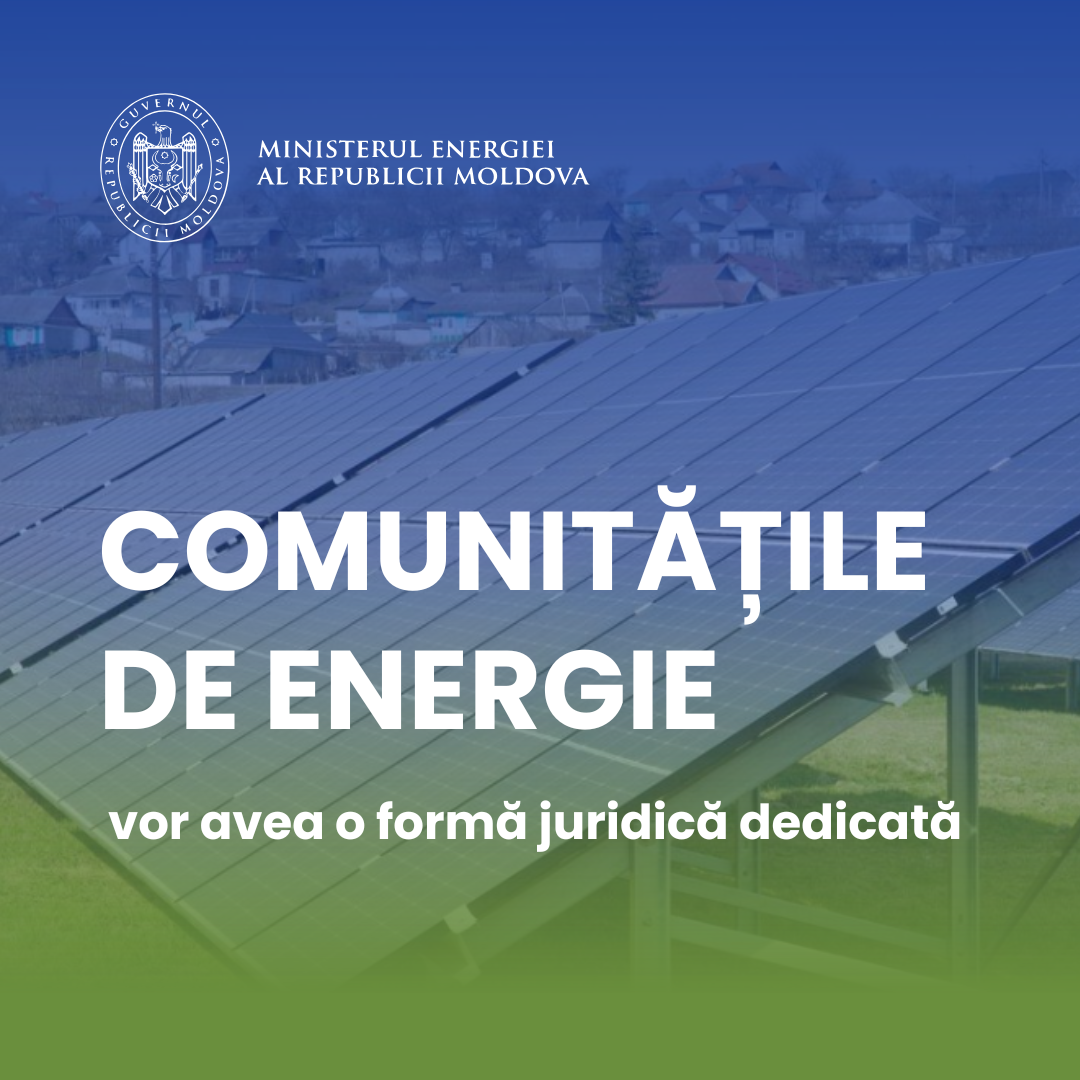
Citizens, local public authorities and businesses will be able to associate more easily to jointly produce, consume, store and manage energy, including energy from renewable sources. The Government has approved the draft law developed by the Ministry of Energy, which introduces a dedicated legal form for energy communities.
Renewable energy communities and citizen energy communities are already provided for under the legislation of the Republic of Moldova, but until now they have not had a legal form of their own. The four pilot communities developed with the support of UNDP Moldova in Logănești, Cociulia, Chișinău and Codru were established under existing legal forms, such as limited liability companies and non-governmental organizations. The experience of these projects has shown that the available legal forms do not fully reflect the specific nature of energy communities and do not allow all the principles underpinning them to be fully applied.
In this context, the draft law introduces a dedicated legal form that will enable energy communities to be established and operate within a framework adapted to their specific characteristics. The draft law was developed with the support of UNDP Moldova and with financial support from Norway, Sweden and Italy.
“Energy communities give people the opportunity to become active participants in the energy system. With a clear legal form in place, citizens, local authorities and entrepreneurs will be able to associate, produce energy, use it more efficiently and jointly develop projects that bring benefits to the community,” said Minister of Energy Dorin Junghietu.
The new legal framework proposes the creation of a special and optional legal form in the form of a non-profit, non-political association with legal personality. This will provide the legal basis for establishing a community, which may subsequently apply to the National Agency for Energy Regulation to obtain the status of a renewable energy community or a citizen energy community, in accordance with the legislation.
The new legal form will allow different types of members to join, including individuals, local public administration authorities and municipal enterprises, as well as small and medium-sized enterprises, homeowners’ associations, public institutions and other eligible entities. Participation will be voluntary and open, while decisions will be taken according to the principle of “one member – one vote”, ensuring effective control by members over the community’s activities.
The draft law facilitates the transfer for use of immovable property and energy infrastructure owned by local public authorities to the community in which the authority holds membership. The National Centre for Sustainable Energy (CNED) will develop and publish a model founding act/statute, which will be made available to all interested parties to facilitate the registration process and reduce related legal costs.
Communities will be able to develop joint projects for the production and use of energy, including energy from renewable sources, as well as for its storage and management. Their main purpose will be to generate economic, social or environmental benefits for members and for the community in which they operate, rather than to distribute profits among members.
The draft law does not limit the possibility for members to use other legal forms provided for under sector-specific legislation. At the same time, the creation of the new legal form does not involve the introduction of additional taxes or duties and does not generate expenditures from the state budget. Communities will be able to finance their activities through membership fees, income from their own activities, donations, grants and other sources provided for by law.
The creation of a clear legal framework will allow the experience of pilot projects to be expanded and new local energy initiatives to be developed. Energy communities can contribute to increasing decentralized renewable energy production, reducing energy costs and strengthening community resilience.
The measure contributes to achieving the objectives of the National Integrated Energy and Climate Plan, which provides that, by 2030, electricity generated from renewable sources should account for 31.2% of gross final electricity consumption.
 [1]